
Author: Gudmundur Alfredsson
Date Posted: August 10, 2026
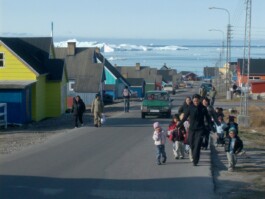
Greenland 5, Ilulissat, street scene with children, by Vincent van Zeijst, licensed under the Creative Commons Attribution 3.0 Unported license.
The Greenlanders and the Right of Self-Determination
In 1946, Denmark listed Greenland as a colony under Chapter XI of the UN Charter, and during the period of 1946-54 Denmark reported regularly to the United Nations ('UN') on the situation in the non-self-governing territory. The information provided was often incomplete or seriously misleading if not outright false. In some striking submissions it was stated that the Greenlanders, because of the mixing with Danish blood, ‘can no longer be said to be of the Eskimo race’ (See Alfredsson, pp. 76–77).
Denmark ratified the UN Charter in 1945. According to Article 73 in Chapter XI, colonial powers ‘accept as a sacred trust the obligation to promote to the utmost … the well-being of the inhabitants of these territories, … to develop self-government, to take due account of the political aspirations of the peoples, and to assist them in the progressive development of their free political institutions …’. In line with the Charter provisions, the General Assembly adopted in 1952 and 1953 several Lists of Factors by way of resolutions which elaborated in detail what decolonisation was about (General Assembly resolutions 567 (VI) of 18 January 1952, 648 (VII) of 10 December 1952, and 742 (VIII) of 27 November 1953).
Since the 1950s, a decolonisation rule has been reinforced by instruments like the Declaration on the Granting of Independence to Colonial Countries and Peoples (adopted by General Assembly resolution 1514 (XV) of 14 December 1960) and General Assembly resolution 1541 (XV) of 15 December 1960 on the principles which should guide States in determining whether or not an obligation exists to transmit the information called for under Article 73. These resolutions, along with the UN Charter, the UN and State practice and several decisions of the International Court of Justice, clearly establish political decolonisation of overseas non-self-governing territories as a rule of law.
Denmark in 1953 sought to bring her obligations as a colonial power to an end by incorporating Greenland as a province. In doing so, Denmark disregarded the right to self-determination and the law of political decolonisation, as well as Greenland’s geographic separation from Denmark across the North Atlantic Ocean, the colonial history, the lack of political development in the colony, and the cultural, linguistic and other ethnic and economic differences between a colonial power and an overseas territory. The timing was carefully selected, shortly before the implementation of the UN Charter provisions on decolonisation gained speed on the ground and in the UN and State practice.
The situation in Greenland prior to the alleged integration did not live up to the demands of the UN Charter. Self-government was not in place. Also, in 1953 there was no referendum in Greenland about the integration and the accompanying constitutional setup, while one was held in metropolitan Denmark.
The municipal-level body in Greenland consulted about integration was chaired by the Danish Governor, and it was given only a couple of days for the task. It did not have a mandate or authority to take constitutional decisions on behalf of the Greenlanders. It also did not have representatives from Greenland's east and northwest coasts. The integration process as managed by Denmark was thus one-sided and undemocratic; it could not then and cannot now stand the test under contemporaneous as well as subsequent laws relating to decolonisation, democracy and human rights (See Alfredsson, pp. 290–308).
As to the decolonisation options, drawing on the UN Charter and subsequent practice, Principle VI of resolution 1541 (XV) provides that full self-government of a non-self-governing territory can be achieved through the emergence of a sovereign independent State; free association with a State; or integration with an independent State. Neither independence nor free association were made available to the Greenlanders; integration was the only choice on offer from Denmark.
Of these options, the meaning of independence is quite clear, but free association is less known. In Principle VII of resolution 1541 (XV), it provides that free association should be ‘the result of a free and voluntary choice’ expressed through informed, democratic and constitutional processes and the peoples of the territory should retain the freedom to modify that status. It also means that any attempt to alter Greenland’s status along the lines proposed by President Trump – including through a free association arrangement with the United States – would require the free and informed consent of the Greenlandic people (See Alfredsson, pp. 54–61). Existing examples of this model include the Marshall Islands, Micronesia and Palau, all of which are UN Member States and maintain free association agreements with the USA.
As to integration, complete equality between the peoples concerned is among the requirements according to Principles VIII and IX of resolution 1541 (XV). The territory in question should also have attained an advanced stage of self-government and made its choice through informed and democratic processes. Again, with integration as the only option offered by Denmark, the integration process fell far short of the requirements set forth in Article 73 and the Lists of Factors with regard to both substance and procedure.
With colonial powers still steering the debate at the time, the General Assembly in resolution 849 (IX) took note of the integration and Danish reporting came to an end. Based on information submitted by Denmark, resolution 849 (IX) entitled ‘Cessation of transmission of information under Article 73e of the Charter in respect of Greenland’ was mainly about procedure (reporting) and not substance. The wording is noteworthy as the Assembly ‘took note’ of the integration rather than ‘agreed to’ or ‘accepted’ it. Resolution texts like these are carefully drafted, and the text does not grant or endorse Danish sovereignty over Greenland. Even if resolution 849 (IX) were understood differently, it could and should be challenged, along with other arguments, on the basis of major shortcomings of the process in Greenland and the inaccurate and misleading information submitted to the UN.
Since 1953/54, integration as a matter of both law and fact has not been realised; certainly, it did not bring about the promised equality. In subsequent decades, discrimination has frequently occurred in terms of use of language, access to education, political and economic participation, public and private employment and remuneration, housing and other areas. Removal of children to Denmark, coercive pregnancy prevention, the closing of small settlements without consent, and several other wrongdoings constitute additional human rights violations.
It was not until 1979 that Greenland was granted self-government under the label of Home Rule. While maintaining the unity of the realm and reserving Danish control over defence, foreign affairs, border control, judicial and monetary affairs, the Home Rule Act delegated a series of local functions to legislative and executive bodies of a local government, as well as an advisory role relating to Danish national and international actions affecting Greenland’s interests. Under separate Danish legislation, which itself was the outcome of unequal negotiations between the parties, Greenland’s mineral resources were placed under a scheme of joint decision-making and profit-distribution (See Foighel, pp. 91–108; See Scarpa, pp. 84–117).
An all-Greenlandic Self-Governance Commission (2001-03) was followed by a Joint Commission (2004-08), which produced a legislative bill along with a detailed report on expanded autonomy. Still in force, this Self-Government Rule has conferred significantly more powers than those that were delegated to Nuuk under the Home Rule. The Self-Government Act (Article 21 and preamble) expressly recognises that the Greenlanders are a people with the right of self-determination which, subject to approval by referendum in Greenland and other approval processes, includes the option of independence. The Act does not use the term ‘indigenous peoples’.
Interestingly, when Denmark officially informed the UN about the new Self-Governance Act, the letter was published as a General Assembly document (UN document A/64/676) under an agenda item on the implementation of decolonisation. In other words, the process is still ongoing.
Denmark covers expenditures for matters not yet handed over to the Greenland Government, including the police and the courts. Denmark also subsidises the Self-Government budget with a grant of about 4.3 billion DKK per year. The dependency on Danish funding (See Scarpa, pp.118–148) often enters Greenland’s political discourse but, nowhere in official reports or statistics, has this author come across figures, neither precise nor estimated, for the direct and indirect income and other benefits that Denmark derives from her control of Greenland.
Greenland became part of the European Communities (EC) when Denmark joined in 1973, but the Greenlanders decided in a 1982 referendum to withdraw; both Brussels and Copenhagen agreed to this exit which took effect in 1985. Thus, while Denmark is still an EU Member State, Greenland enjoys the status of an Overseas Country and Territory (OCT); in addition, Greenland has a number of other agreements with the EU on various matters such as education and fisheries. Under these arrangements, the EU contributes increasing financial amounts to Greenland’s Government budget.
My conclusions are short and to the point. The Greenlanders are a people (a nation) with the right of external self-determination under both Danish and international law. A draft Constitution is pending before Greenland's Parliament. It is for the Greenlanders alone to decide, in the years ahead, whether and when they pursue independence, free association (with a country of their choice) or integration (again with a country of their choice).
Professor Gudmundur Alfredsson, an Icelandic lawyer, obtained the SJD-degree from Harvard Law School in 1982, with a dissertation on Greenland and the Right to External Self-Determination. He served with the all-Greenlandic Self-Governance Commission (2001-03), the North Atlantic Group at Folketinget (2003-04), the Joint Self-Governance Commission (2004-08) and the §21 Commission (2025-present). He has held teaching positions on international law and human rights at Universities in Akureyri, Beijing, Lund, Nuuk, Riga, Strasbourg and Washington DC, he was among the founders of the Polar Law Symposia (from 2008) and the Yearbook of Polar Law (Brill), and he is now Senior Associate with the Stefansson Arctic Institute in Akureyri. He was Director of the Raoul Wallenberg Institute of Human Rights (1995-2006), UN staff member in New York and Geneva (1983-95), expert member of the UN Human Rights Sub-Commission (2004-06) and chair of the OSCE drafting group of the Lund Recommendations on the political rights of minorities (1998-99).

Cambridge International Law Journal
Faculty of Law, University of Cambridge
10 West Road
Cambridge CB3 9DZ
United Kingdom

General Enquiries: editors@cilj.co.uk
Blog Enquiries: blog@cilj.co.uk
Conference: conference@cilj.co.uk
Cambridge International Law Journal
Faculty of Law, University of Cambridge
10 West Road
Cambridge CB3 9DZ
United Kingdom
General Enquiries: editors@cilj.co.uk
Blog Enquiries: blog@cilj.co.uk
Conference: conference@cilj.co.uk