
Author: Gabriela García Escobar
Date Posted: March 5, 2025
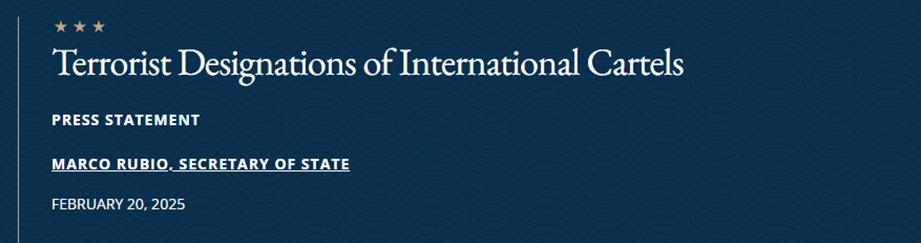
On 20 February 2025, the US government officially declared six Mexican drug cartels as foreign terrorist organisations. The designation process was triggered due to President Trump’s concern over the trafficking of fentanyl and migrants by these organisations.
Since 2020, due to the massacre of the LeBaron Mexican-American family, some members of the Republican Party have been calling to designate Mexican drug cartels as terrorist organisations and to consider the possibility of applying measures similar to those of Al-Qaeda or the Islamic State (ISIS).
This measure pretends to help American law enforcers combat drug cartels by giving them more power to freeze cartel assets and deny members entry to US soil. However, Mexican authorities fear that this designation could be used to justify unconsented military operations in Mexican territory (through a “soft invasion,” as some American politicians have called it) invoking the right to self-defence.
Thus, this post aims to analyse the legal consequences of such designation from an international law perspective, specifically the ius ad bellum, to determine whether the US could invoke a right to self-defence against drug cartels operating in Mexican territory. As it would be explained, even under an expansive interpretation of this right, following the practice of the US regarding the war on terror, American military operations could not be justified as self-defence, as international law stands today. Rather, if they occur, unconsented military operations could constitute an act of aggression, as it would violate Mexico’s territorial sovereignty, even if the operations are not conducted against the Mexican army.
Self-Defence against Terrorist Organisations
Under international law, it is indisputable that using armed force against another state’s territory, sovereignty, or political independence constitutes a violation of Article 2(4) of the UN Charter regarding the prohibition of the use of force. Any armed attack by American troops against Mexico would be characterised as an act of aggression (according to UN General Assembly’s Resolution 3314(XXIX) of 1974).
The only possible exception that could preclude the wrongfulness of these attacks (as established in Article 21 of ARSIWA) would be the right to self-defence. Although the US government has not expressly invoked this right in this context, American authorities refer to their actions as part of a national security strategy, which suggests an argument that would rely on this exception.
However, the right to self-defence can only be triggered in response to an “armed attack.” As will be explained, international law debates whether non-state armed groups (NSAG) are capable of committing an “armed attack.” For the sake of the argument, it is important to highlight that so far, drug cartels have not used armed force against the US. However, this post will explore whether an attack launched by a drug cartel against the US could be classified as an “armed attack” that triggers this right.
Two Approaches to Defining “Armed Attack”
According to Article 51 of the UN Charter, self-defence can only be invoked in response to an “armed attack,” traditionally understood as the use of armed forces of one State against another. Considering that the prohibition on the use of force (Article 2.4 of the UN Charter) is an inter-State obligation, then the exception to the general rule (Article 51) should be interpreted in those terms.
This implies that drug cartels cannot commit armed attacks, which excludes the possibility of targeting (in self-defence) NSAG in another state’s territory without that State’s consent. As Tom Ruys argues, this narrow approach is supported by the drafting process of Article 51 and followed by many States, including Mexico.
According to this approach, non-state actors can only commit an armed attack when they are sent “by or on behalf of a State” and when the attacks are of “such gravity” as to amount to an act of aggression (Resolution 3314, Article 3(g)). Thus, invoking the right to self-defence in this context requires that the NSAG’s attacks be attributable to a State, which requires that the NSAG was acting under the instructions, direction, or control of a State, as articulated in Article 8 of ARSIWA.
According to the ICJ’s arguments in this regard (as articulated in Nicaragua and the Genocide cases), the test of attribution would require either (1) proofing a relationship of “complete dependence” between Mexico and the cartel, to the point of considering the cartel as a de facto state organ; or (2) that Mexico exercised effective control over the military operation that caused the armed attack. Thus, these requirements imply that the threshold to prove the nexus of attribution is challenging.
However, there is a second approach that has received increasing support in the last two decades and that has been embraced by the US since the 9/11 attacks by Al-Qaeda. Some scholars and States (e.g., Belgium, Germany, and Norway) maintain that Article 51 does not constrain the definition of “armed attack” to an inter-State scenario. This narrow approach was criticised by a minority of judges in the Wall Advisory Opinion and left open in the case of Armed Activities. Furthermore, Security Council’s Resolutions 1368 (12 September 2001) and 1373 (28 September 2001) have been understood as extending self-defence to terrorist attacks.
This approach could hypothetically justify a reaction in self-defence if a drug cartel launches an attack against the US. However, further considerations need to be taken into account before adopting this expansive interpretation of Article 51.
A Global Consensus Towards the Recognition of Self-defence against NSAG?
Some scholars have been too enthusiastic that this approach already constitutes lex lata, as it is perceived as an unstoppable trend among States. Nevertheless, four caveats require further analysis.
Thus, in any event, the US would have to demonstrate that any of these scenarios has been reached in a particular case.
What are the Possible Outcomes?
As explained, the legality of the right to self-defence against NSAG remains an open discussion. Although some scholars and Western States share this expansive interpretation, it is not universally accepted. Latin American states, especially Mexico, have continuously expressed concerns and disagreements. This is of utmost relevance in this debate, as they can be considered as specially affected states in the crystallisation of a customary norm in this issue.
On the other hand, it is possible that this situation will not trigger further international legal consequences. Trump’s designation of drug cartels as foreign terrorist organisations might be more a measure of political pressure against the Mexican government than a real threat. During Trump’s meeting with President Claudia Sheinbaum, he agreed to pause the imposition of 25% tariffs on Mexican products after Mexico committed to supply 10,000 soldiers on the border to stop the flow of drugs and illegal migration.
It seems that Mexico has even taken further measures as a response, like a new constitutional amendment of Article 19 to extend pre-trial detention for crimes related to the production, storage, or distribution of fentanyl.
Another possible scenario is a joint military strategy between the Mexican and American governments, like the Merida Initiative of 2008. The president of the Mexican Commission on National Defense has already said that cooperation with the American government in conducting military operations against drug cartels is possible. In that case, no internationally wrongful act would be committed as Mexico would consent to the military operations.
Dr. Gabriela García Escobar is a Professor of Public International Law and International Human Rights Law at Universidad Panamericana (Mexico). She holds a PhD in Law from the University of Geneva and a Master in International Law from the Graduate Institute of International and Development Studies of Geneva.

Cambridge International Law Journal
Faculty of Law, University of Cambridge
10 West Road
Cambridge CB3 9DZ
United Kingdom

General Enquiries: editors@cilj.co.uk
Blog Enquiries: blog@cilj.co.uk
Conference: conference@cilj.co.uk
Cambridge International Law Journal
Faculty of Law, University of Cambridge
10 West Road
Cambridge CB3 9DZ
United Kingdom
General Enquiries: editors@cilj.co.uk
Blog Enquiries: blog@cilj.co.uk
Conference: conference@cilj.co.uk