
Author: Iryna Marchuk
Date Posted: August 3, 2026
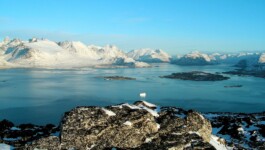
Scenery from Ravnefjeldet, Nanortalik (Southernmost part of Greenland) on a clear December morning, by Jensbn, licensed under the Creative Commons Attribution-Share Alike 3.0 Unported license.
The geopolitical storm surrounding Greenland has laid bare a profound transformation of the Arctic order. For decades after the Cold War, the Arctic was known as a peaceful region largely free of geopolitical tension. That era is over. The region has entered a new phase defined by great power rivalry over resources, military superiority, and regional dominance, while Greenland finds itself caught at the centre of these competing interests, fighting to protect its land and the rights of its people. This geopolitical turbulence, compounded by disinformation, misinformation and diplomatic extremes, has also muddied the waters surrounding important questions under international law: the right of the Greenlandic people to self-determination; the enduring impact of post-colonial legacy on the agency of Greenland and its people; the Indigenous rights of the Greenlandic people, including their rights to lands and natural resources; and the legal avenues available to smaller states to uphold their sovereignty and territorial integrity.
The purpose of this Symposium is to bring Greenland to the centre of the academic debate – not as an interesting case study, but as a means of reinforcing the agency of Greenland and the Greenlandic people in shaping their own future, in accordance with their values, their way of life, and the values-based principles underpinning the global order. The Symposium opens with a keynote address delivered by the Prime Minister of Greenland, Jens-Frederik Nielsen, to the Copenhagen Democracy Summit in May 2026, published here with his express permission. In his speech, Prime Minister Nielsen acknowledges that Greenland is at the heart of an unravelling Arctic order defined by great power politics, the militarisation of the Arctic and securitisation of resources, while emphasising the resilience of the Greenlandic people rooted in their traditional way of life, and the importance of the rule of law and democratic values as the ‘glue that creates peace and prosperity’. A key message of his address is that ‘small societies depend on a rules-based world’ and that they also bear responsibility for helping to uphold it, even in the most turbulent times. Prime Minister Nielsen’s remarks set the stage for the subsequent contributions, which reflect on the value of international law in containing the dangerous expansionist rhetoric surrounding Greenland that shows no regard for the fundamental principles of sovereignty, territorial integrity, and the right to self-determination.
At the height of the crisis, international law scholars found themselves fielding questions that many had assumed were consigned to the history books. Can the United States purchase Greenland from Denmark? Can it annex Greenland? The ‘purchase’ rhetoric was swiftly and firmly rejected by the governments of Greenland and Denmark, who presented a united front: Greenland is ‘not for sale’, and ‘Greenland belongs to the people of Greenland’. International law is unambiguous on these points. The acquisition of territory by the threat or use of force is prohibited, which forms a cornerstone principle of the post-Second World War global order. Modern international law does not countenance the imperial logic that would permit one State to conquer another; that law of the jungle belongs to the dustbin of history. Any forcible takeover of Greenland – even one met with no local armed resistance, as was witnessed in Crimea – would trigger the application of the law of international armed conflict. As affirmed by the International Court of Justice in its advisory opinion, ‘regardless of the circumstances in which the occupation was brought about, the fact of the occupation alone cannot confer sovereign title to the occupying Power’ (para 159). The so-called annexation bill introduced before the United States House of Representatives was, in this light, an attempt to obscure public perception about the limits of permissible state conduct – limits, that are, in fact, entirely clear. Both Article 2(4) of the UN Charter and customary international law prohibit the threat or use of force against the territorial integrity of any State. The only narrow avenue for territorial transfer under international law, known as cession, requires the consent of the transferring State and must be consistent with the right to self-determination. Neither condition is met here.
The Symposium brings together Prime Minister Nielsen’s address and contributions from leading international law scholars whose expertise is deeply embedded in the Greenlandic context, both through their research and practical engagement. Professor Gudmundur Alfredsson examines in depth the right of the Greenlandic people to self-determination, the impact of the post-colonial legacy on the discourse surrounding self-determination, and possible pathways toward the future legal status of Greenland, be it independence, free association, or integration. Associate Professor Miriam Cullen, in her contribution, emphasises the broader spectrum of international human rights obligations in any contemporary discussion of territorial acquisition and sovereignty. This is followed by a contribution from Professor Jacques Hartmann, who explores the international legal and political avenues potentially available to Denmark for responding to the United States’ claims over Greenland, including recourse to the United Nations, diplomatic and political pressure through EU and NATO allies, and the leveraging of existing treaty obligations, keeping in mind the significant asymmetry in military and geopolitical power. The Symposium is concluded by my own contribution, initially published in February this year, which discusses the broader implications of the crisis surrounding Greenland for great power rivalry in the Arctic and international law.
It is our hope that this Symposium advances an academic debate on Greenland that is grounded in respect for the rights of the Greenlandic people and their vision for the future of their home. In this fog of disinformation and geopolitics, international law provides essential guidance and clarity on the limits of permissible state conduct that must, at all times, respect sovereignty and the right of peoples to self-determination.
Dr Iryna Marchuk is an Associate Professor of International and Criminal Law at the Faculty of Law, University of Copenhagen, Denmark. She is also the Principal Investigator of the EASTERNISATION project, which examines power shifts and the regionalisation of international law, supported by the Danish Independent Research Fund.

Cambridge International Law Journal
Faculty of Law, University of Cambridge
10 West Road
Cambridge CB3 9DZ
United Kingdom

General Enquiries: editors@cilj.co.uk
Blog Enquiries: blog@cilj.co.uk
Conference: conference@cilj.co.uk
Cambridge International Law Journal
Faculty of Law, University of Cambridge
10 West Road
Cambridge CB3 9DZ
United Kingdom
General Enquiries: editors@cilj.co.uk
Blog Enquiries: blog@cilj.co.uk
Conference: conference@cilj.co.uk